Some interiors make you want to stay the moment you walk in. Not because they are big or expensive, but because they have something hard to pin down – warmth, character, a sense that someone has truly thought them through. A retro living room is exactly that kind of space. A few well-chosen pieces of furniture, warm wood, one bold colour on the wall and details that tell a story – and suddenly an ordinary living room becomes a space with soul.
A retro style living room is not about recreating a museum display. The goal is not to make your home look like a still from a black-and-white film. It is something subtler: taking what is timeless from the past and weaving it into the space you live in today. Retro living room inspiration draws on history, but it speaks about the present.
Where to Start? A Philosophy Before You Shop
Before you start looking for specific pieces, take a step back and ask yourself one question: what is it about retro style that draws you in? The warmth of natural wood and the slender legs typical of the 1960s? The bold colours and geometric patterns of the 1970s? The elegance and classic simplicity of post-war design? Or perhaps the feel of Polish mid-century (PRL-era) homes, which suddenly seems surprisingly modern?
Your answer sets the direction and protects you from the most common mistake: collecting retro props with no internal coherence. A retro living room built without a guiding idea is just a jumble of old things. A retro living room built with intention is an interior with character.
Old-Style Living Room Furniture – What Defines the Choice?
Old-style furniture for the living room has a few features that set it apart from today's mass production. The first and most important is natural wood – with a visible grain pattern, a warm tone and a natural texture. Not paper foils, not laminates pretending to be wood. Real oak, walnut, teak – species that carry warmth and history within them.
The second is the legs – slender, often angled, lifting the piece off the floor. This is the detail that, more than anything else, defines retro and mid-century aesthetics: the furniture does not sit on the floor like a block but floats above it on elegant supports. The space beneath the piece stays visible – the floor breathes and the room gains depth.
The third is proportion and form – clean lines without unnecessary decoration, harmonious dimensions, no ornaments. The paradox of retro is that furniture in this style is both simple and elegant. Simplicity here does not mean poverty of form – it means its perfection.
Sofa and Armchairs – the Heart of a Retro Living Room
A living room starts with seating. In a retro scheme, the sofa should sit low, with a straight back, on slender – ideally wooden – legs. Fabric matters: velvet, corduroy, bouclé, natural linen – all materials that fit the aesthetics of the era while looking great in contemporary interiors.
For the sofa colour, choose either safe neutrality – cream ecru, light grey, natural beige – or one bold, deliberate choice: mustard yellow, deep bottle green, brick terracotta. Intense fabric colours against a neutral wall create a tension that is at the heart of a good retro interior.
Armchairs complete the lounge area and give the living room its character. A 366-style armchair – a slim wooden frame, a wide seat, a straight back – is a timeless classic. A wingback chair on wooden legs, upholstered in velvet, suits those who want a touch more elegance. Both are true examples of Polish and European post-war design, which is now enjoying a well-deserved revival.
Coffee Table – Geometry at Floor Level
In retro and mid-century style, a practical coffee table is low, with a clear geometric form – a rectangle, a circle or an organic oval – and slender legs. A top in solid wood, veneer or glass on a wooden base, perhaps with brass details: these variations fit the look effortlessly.
The coffee table is also where you can afford a little daring: an interesting shape, an unusual combination of materials, something that catches the eye. In a retro living room, the coffee table is often the one piece that sets the tone for the entire seating area.


Bookcase – a Showcase of History and Character
In a retro living room, a bookcase is more than a place for books. It is the wall on which the living room tells its story – through the objects displayed on it, the material it is made from and the form that sets the rhythm of the whole space.
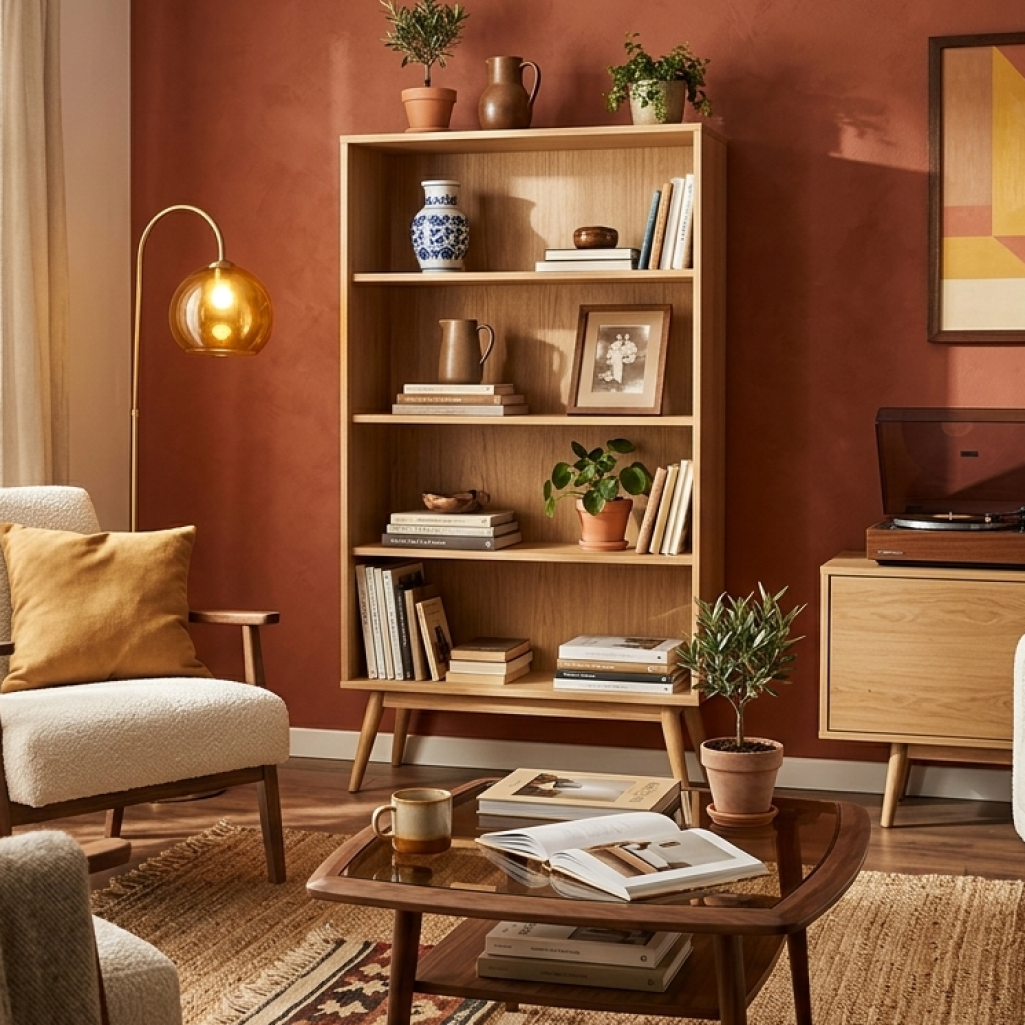
A retro-style bookcase stands on characteristic slender legs, is made of warm wood and has an open or partly closed structure. The shelves display what deserves to be seen: books stacked alternately upright and flat, ceramics in deep colours, plants, framed photos, keepsakes with a story.
The key to a beautiful retro bookcase is balancing full and empty space. Overloaded shelves lose their lightness – and lightness is the essence of the whole style. A few carefully chosen objects against visible wood always look better than every centimetre of shelf filled to the brim.
A solid wood bookcase on angled legs is a piece of furniture that is a decoration in itself. It stands against the wall and changes its character, giving it rhythm, warmth and depth that no wallpaper or painting can replace.
Sideboard and TV Unit – Low Profile, High Elegance
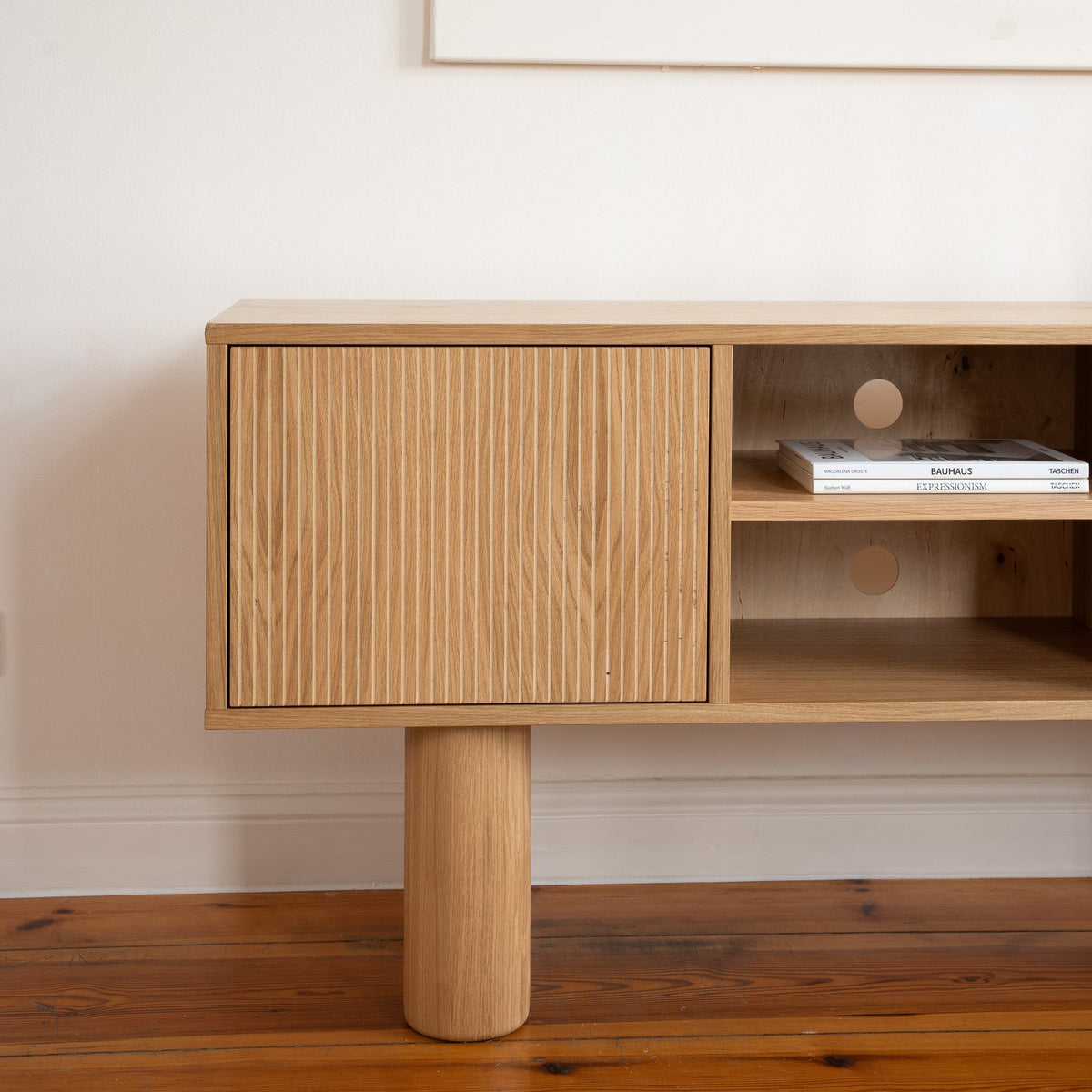
There is no room for bulky, tall storage furniture in a retro or mid-century living room. Instead, the low, horizontal retro sideboard with drawers reigns – a piece with a clearly horizontal character, several drawers or doors, slender legs and a warm wood finish.
A sideboard like this does several jobs in the living room at once. It stores what you want to hide away. Its top displays what you want to show – vases, a lamp, ceramics or a stack of books – giving the wall behind it a focal point.
A retro-style TV unit is a version of the sideboard adapted to modern needs: a wide top for the television, space for equipment, drawers or internal shelves. Done well, it means the TV stops being the dominant feature of the living room and becomes just one element of a well-considered whole.
Colours and Walls – Boldness That Pays Off
Retro living room colour inspiration comes from a palette that is both warm and expressive. The idea is for at least one element of the room to have some temperament. An accent wall behind the sofa or bookcase is where colour courage works best. Deep bottle green, navy, brick red, dark sage – each of these colours creates a backdrop against which wood and a light sofa fabric resonate at full strength.
Wallpaper with geometric or floral patterns is an option for those who want a stronger retro accent. Paper one section of the wall, keep the rest neutral – and the living room gains remarkable character without the risk of overload.
If you prefer a calmer approach, go back to the golden rule: a light, neutral base and one striking colour introduced through upholstery, cushions, vases or a rug. Less is often more – especially when that "less" is chosen really well.
The Rug – a Pattern That Ties Everything Together
In a retro living room, the rug is not just background – it ties the whole composition together and defines the boundaries of the seating area. Geometric rugs work well in retro and mid-century interiors – simple patterns in a few colours, no ornaments, with a clear rhythm of repeating motifs. Plain rugs with a chunkier weave also work, adding texture without visual clutter.
The colour of the rug should relate to the palette of the whole living room – either as a continuation or as a deliberate accent. A mustard rug under a cream sofa, next to a warm wood bookcase, is a classic combination that always works.
Lighting – Warm, Atmospheric and Sculptural
In a retro living room, lighting is as important a decorative element as the furniture. A floor lamp with a globe shade on a slim metal stand, a brass-coloured cone pendant above the coffee table, a wrought-metal wall light beside the sofa – all of these both provide light and create atmosphere.
The colour temperature is crucial: a warm, yellowish tone (2700–3000 K) brings out the beauty of wood, enlivens fabrics and creates the cosy atmosphere that lies at the heart of every good retro interior. Cold white light kills the mood instantly, no matter how good the furniture is.
Old-Style Furniture and Modern Practicality – Are They Mutually Exclusive?
One of the most common questions is: is retro furniture practical in a modern home? Can you really live, work and relax in a living room with a sideboard on angled legs and a 1960s-style bookcase?
The answer is simple: not only can you – this is precisely the style that was created with everyday life in mind. Mid-century and retro design was functional by definition. The designers of that era did not make furniture for show – they made it for people with small homes, who worked, relaxed and raised families.
Summary
A retro living room combines everything we look for in modern life: the warmth of natural materials, the calm of clean forms and character born of considered choices. You do not need a museum collection or an unlimited budget. You need a few really good pieces of furniture, one bold colour, a few plants and ceramics – and the belief that beauty lies in simplicity, not in excess.
A retro living room draws its inspiration from history, but it creates an interior for today.