Not so long ago, grandad's old armchair went straight to the tip. Old, covered in a fabric nobody made any more – it was thrown out without a second thought to make room for something modern from a chain store. Today that same armchair draws admiration in design galleries, fetches serious prices at auction and is coveted in thoughtfully furnished homes all over the world.
What has changed? Not the armchair. The way we look at it.
Retro furniture – in this case Polish mid-century (PRL-era) furniture, made in the Polish People's Republic in the 1950s, 1960s and 1970s – is enjoying a genuine renaissance. Not out of nostalgia for a bygone era, but because of something far more lasting: timeless design that waited decades to be rediscovered and properly appreciated.
Where did Polish mid-century furniture come from – and why was it so good?
Communist-era Poland was not a place that nurtured individual talent or innovation for its own sake. And yet, paradoxically, the very conditions that should have killed good design created an exceptional environment for it.
Furniture designers worked amid permanent shortages: no materials, no space, no modern technology, small flats and tight budgets. These constraints gave rise to solutions that were brilliant in their simplicity. Furniture had to be light, multifunctional and economical to produce, and suited to small homes. Sound familiar? That is exactly how you would describe a good piece of mid-century modern furniture – the same movement that, at the very same time, was winning over designers and buyers in the West.
Why is "old Eastern Bloc furniture" so sought after today?
The answer has many dimensions – and none of them is accidental.
- Authenticity and history. We live in an age of mass production, where chain-store furniture looks identical in homes all over the world and goes out of fashion faster than its warranty runs out. Against this backdrop, a piece of furniture with a history – one that has survived several decades, perhaps stood in your parents' or grandparents' home and bears the marks of genuine use – has something no new production can give it: soul and identity.
- Quality of materials and workmanship. Paradoxically, although the communist era is associated with shortages and mediocrity, furniture from that period was often made from solid wood or natural wood veneer. No MDF, no chipboard, no paper foils. That is why a 1960s armchair, once restored, can look better than a new piece bought a month ago.
- Design that does not age. Clean lines, considered proportions and functional forms free of unnecessary ornament – these are the qualities that make good design timeless. The 366 armchair was designed for a 1960s flat, but it looks just as good in a modern loft, a Scandinavian living room or a minimalist studio.
- Sentiment – but not only. For the older generation, these pieces carry memories – of childhood, the family home, grandma's living room. For younger generations they are a discovery: something unseen, fresh and surprisingly modern despite its age. It is a rare combination that keeps their popularity going.
How to bring Polish mid-century furniture into a modern interior
This is where the real art begins. Trying to recreate a 1970s interior literally – a wall unit, Turkish-pattern rugs, crystal glasses behind a glass door – will end in a design disaster. The atmosphere should inspire, not recreate.
When introduced wisely into a modern space, Eastern Bloc-era furniture works as a deliberate contrast and enrichment – not as a museum. A few rules that work in practice:
- One or two strong accents, not overload. A 366 armchair upholstered in mustard herringbone fabric, placed by the window against a white wall – that is enough to give the space character and history. Three such armchairs in one room plus a wall unit is a different story altogether.
- Restoration rather than reproduction. Original Polish mid-century furniture that has been professionally restored – new upholstery, refreshed wood, damaged parts replaced – looks fantastic and retains the value of authenticity. If, however, you would prefer a new piece inspired by that aesthetic, look for makers who draw on this heritage deliberately and with genuine craftsmanship.
- A neutral or minimalist setting. Polish mid-century furniture looks most beautiful against calm, neutral spaces – a white wall, a light floor, clean lines. In such surroundings, the 366 armchair becomes a sculpture in the room rather than one of many distracting elements.
- A consistent palette of materials. The warm wood of a vintage Polish piece harmonises beautifully with other natural materials – linen, cotton, jute and the natural wood of other furniture. Pair it with things that share a similar material temperament.


Polish mid-century and mid-century modern – siblings from either side of the Iron Curtain
There is something deeply fascinating about the fact that 1960s design on both sides of the Iron Curtain was heading in a very similar direction – even though designers were working in completely different political, economic and technological conditions.
Chierowski's armchair and the Eames Shell Chair each express the same philosophy: furniture should be beautiful, functional, suited to the average home and made from the best materials available. This shared aesthetic intuition makes Polish mid-century furniture and mid-century modern furniture natural companions in an interior. A 366 armchair next to a coffee table on angled legs, a 1970s retro sideboard beside a solid wood bookcase inspired by mid-20th-century design – these are combinations that look deliberate and harmonious, not random.
From relic to icon – what has really changed?
For years, furniture from communist-era Poland was baggage to be thrown away. It was associated with the ugliness of the system, with shortages and greyness. The transformation of the 1990s brought a fascination with everything Western – and Polish post-war design ended up on the tip en masse.
The change began slowly, roughly in the second decade of the 21st century. Interest in Scandinavian modernism – which is formally a twin of Polish post-war design – opened people's eyes to their own heritage. Museum exhibitions devoted to Polish design, auctions, shops selling restored furniture and the rising prices of originals are all signs that the process of appreciation is ongoing and deepening.
Today, vintage Eastern Bloc-era furniture – especially 1960s pieces inspired by modernist design – are sought-after collector's items. Design galleries sell them at prices that would have seemed absurd just a decade ago. And interior designers treat them as valuable elements of a scheme, bringing to a space what no new piece of furniture can replace: authenticity, history and a form that does not age.
New furniture in the Polish mid-century spirit – where craftsmanship meets tradition
Not everyone wants to, or can, hunt for original pieces from the 1960s. The restoration market can be unpredictable – condition varies, prices are rising and availability is limited. For those who want the aesthetic of that era in a new piece of furniture, without compromising on build quality, the answer is to turn to contemporary craft workshops that deliberately draw on the heritage of Polish and European post-war modernism.
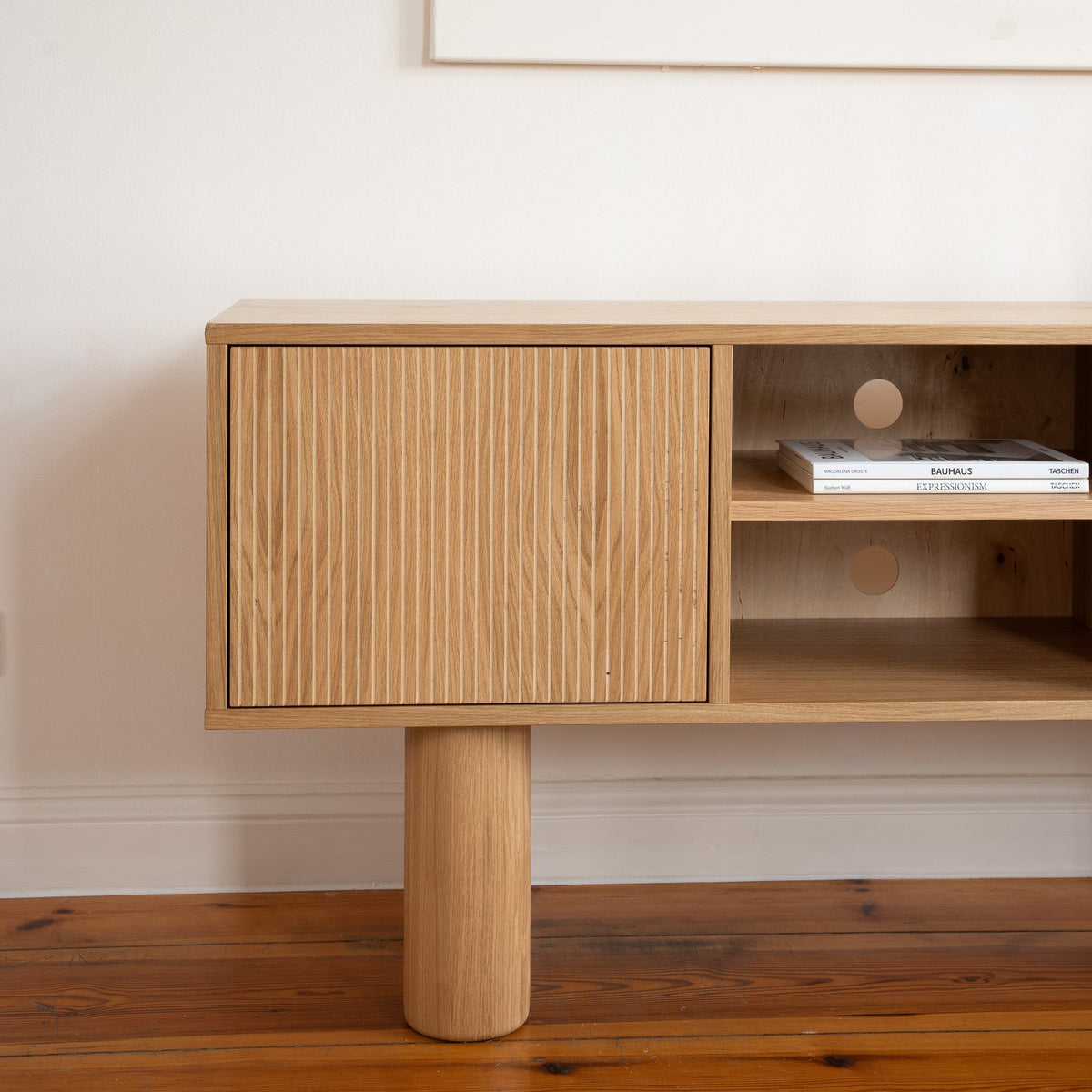
Pastform is a family joinery workshop in Europe, founded in 1997, that creates furniture inspired by 1960s design – made from FSC®-certified solid wood, with no chipboard or MDF. Characteristic angled, turned legs, warm oak with a visible grain and a harmonious simplicity of form – this is a language that refers directly to the tradition of Polish and European post-war design. Our range includes bookcases, retro sideboards, coffee tables and TV sideboards – each piece made with durability and aesthetic coherence in mind.
This is not an attempt to copy Eastern Bloc-era furniture. It is rather the same philosophy – furniture that is beautiful, durable, crafted by hand, free of unnecessary ornament and suited to the realities of a modern home – carried out with today's knowledge, quality standards and understanding of materials. Exactly the way the best designers of that era worked.
Summary
The story of Polish mid-century furniture is a story of how good design overcomes time – and prejudice. For decades, these pieces were treated as relics of a bygone, unwanted era. Today they are design icons, collector's items and coveted elements of thoughtfully furnished interiors.
Polish mid-century furniture and the contemporary designs it inspires share one thing: the conviction that good design does not lie. That pure form, natural materials and considered proportions speak a timeless language – no matter which side of the Iron Curtain they were created on, or in which year.