There is something utterly irresistible about a bathroom that looks like a still from an elegant 1960s film. A black-and-white chequerboard floor, a brass tap with cross-head handles, a mirror in a dark frame, a warm wooden cabinet on slender legs. Nothing loud, nothing random – and yet every element clearly says: this is a place with character and history.
Retro bathrooms have been winning over designers and homeowners for several seasons running. And not without reason – in a world where modern often means cold and clinical, a scheme that references the mid-20th century brings something priceless: warmth, cosiness and the sense that the room tells a story. In this article we have gathered the best retro bathroom ideas – from tiles and taps to cabinets and the small details that change everything.
What exactly is retro style in a bathroom?
It is worth distinguishing straight away between two terms that are often used interchangeably. Vintage style means authentic objects from a bygone era – real taps from the 1950s, original imported tiles, Polish mid-century (PRL-era) ceramics. Retro furniture is inspiration from the past expressed through modern means – new tiles that look old, taps styled on period designs, cabinets whose form references mid-20th-century furniture. Retro does not pretend to be the past – it takes the most beautiful things from it and translates them into the present.
In practice, a retro bathroom is a space dominated by a distinctive, slightly nostalgic aesthetic from the 1940s to the 1970s, natural and noble materials, decorative details and bold yet considered colour combinations. It does not have to be a complete reconstruction of an old bathroom – a few well-chosen elements are enough to give the room that unique atmosphere.
Retro bathroom ideas – where to start?
The strongest foundation of any retro bathroom is the floor. It sets the tone for the whole scheme and is the first thing to catch the eye. A few solutions that work every time:
- A black-and-white chequerboard is the ultimate classic – a timeless combination that evokes old pharmacies, cafés and the elegant bathrooms of pre-war townhouses. It works well in both small and large rooms.
- Hexagonal tiles – hexagons in white, grey or with a subtle pattern – are one of the most characteristic motifs of early 20th-century design and fit perfectly into modern interiors. In 2025, hexagons are enjoying a real renaissance.
- Metro tiles on the wall – small, rectangular tiles laid in a brick bond, herringbone or horizontally – are another element inseparably associated with retro spaces. In white they are classic and timeless; in deep green or navy, striking and bold.
- Terrazzo is a trend that has returned with remarkable force. Retro-style tiles with visible stone chips, patterned mosaic floors, soft pastels – it all sounds like the 1960s and 1970s, yet it fits perfectly with the spirit of contemporary interiors.
Colours – boldness that pays off
Retro bathrooms are not afraid of colour. Where modern minimalism relies on white and grey, a retro scheme reaches for deep green, mustard, terracotta, navy or even burgundy. These are colours with temperament – and that is exactly what makes them so desirable.
You do not have to paint every wall bottle green straight away. One deep colour on a feature wall – behind the bath, behind the washbasin or by the shower – is enough to change the whole atmosphere. The rest can stay neutral white or light beige, which will bring out and balance the intense accent.
A palette that works well with a retro aesthetic includes above all: warm browns and coffee shades (Mocha Mousse, named Pantone's Colour of the Year 2025, fits this direction like no other), muted greens from olive to bottle green, terracotta and rusty brown, deep navy, and as a base – off-white, creamy ecru and soft sand.
Taps and fittings – gold and brass are back on the throne
In a retro bathroom, taps and fittings are not just functional – they are the jewellery of the room. Classic chrome taps are giving way to mixers in brushed gold, brass, matt copper or antique bronze. Characteristic cross-head handles, curved spouts and classic shapes without sharp edges are details that instantly transport a room to another era.
Pay attention to consistent metal finishes throughout the bathroom. This does not mean everything has to be identical – in 2025 it is even fashionable to deliberately mix different metals – but the general direction (warm tones: gold, brass, copper) should be maintained so the scheme reads clearly.
Retro-style ladder radiators made of copper or brass are another element that instantly changes the feel of the space. They become not just a source of heat but also a sculpture on the wall.
Retro bathroom cabinets – the heart of the scheme
In a retro bathroom, furniture is what determines the coherence and character of the whole. Retro bathroom cabinets have a few distinctive features without which it is hard to speak of an authentic atmosphere.
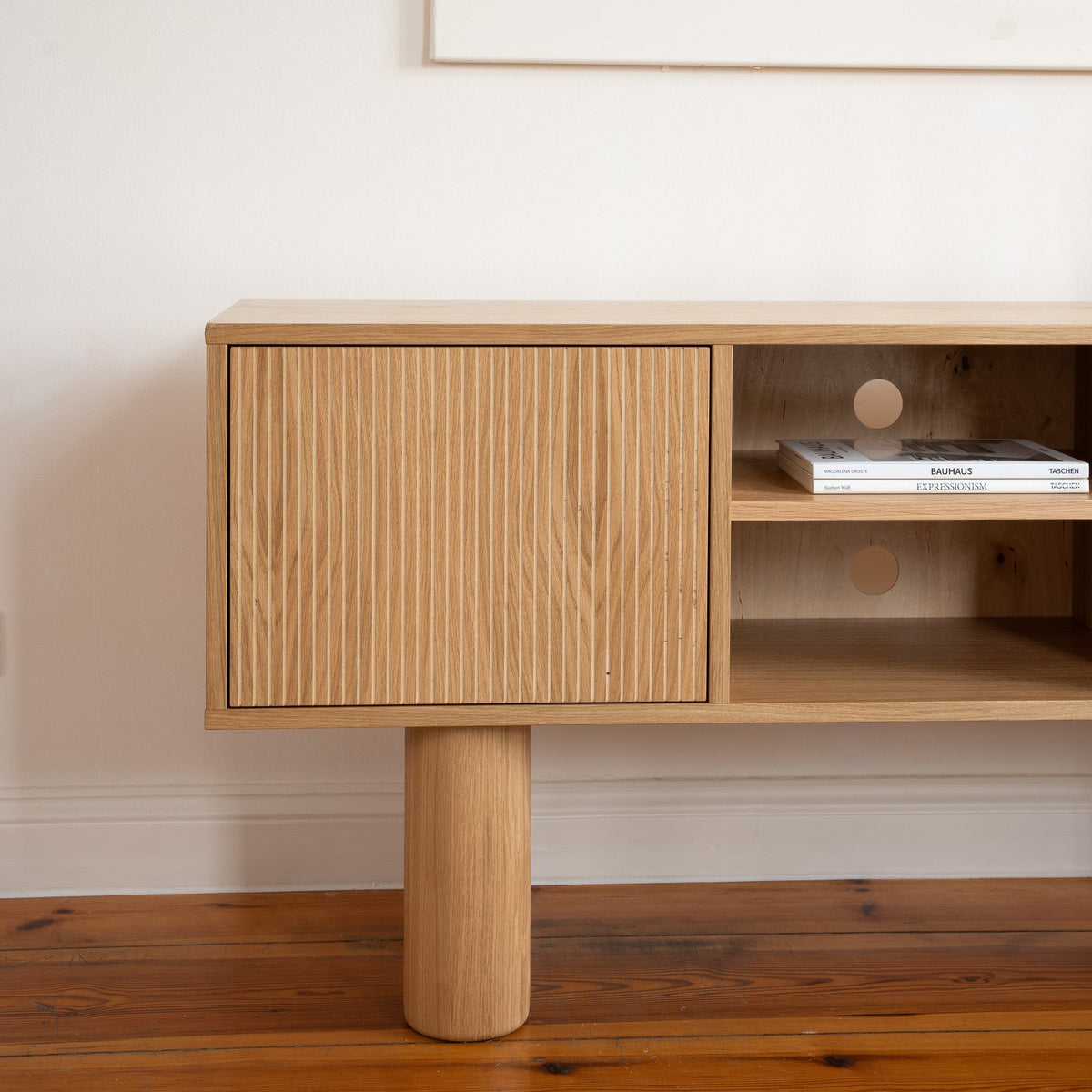
- Legs – just as in mid-century style, a close cousin of the retro aesthetic, bathroom cabinets should stand on slim, often slightly angled legs. They give the piece lightness, lift it off the floor and leave the space beneath it visible – which visually enlarges the room and preserves its retro character.
- Natural wood – warm wood tones, a visible grain, a warm stain in walnut or dark oak shades. In a retro bathroom, wood is not decoration – it is the leading material that defines the character of the room. It is important that it is properly protected against moisture.
- Handles and details – brass, gold or copper handles on drawers and doors are a detail that makes a huge difference. A classic slim bar, a round knob, an ornamental pull – each of these will give the cabinet character and tie it in with the rest of the fittings.
- Fluted fronts – a trend that has been gaining popularity for several seasons. Vertical fluting on bathroom cabinet fronts evokes the aesthetics of the 1960s and 1970s, adds depth and sophistication to the texture and pairs beautifully with brass handles.
When choosing retro bathroom cabinets, remember proportions. In a small bathroom, one well-chosen cabinet on legs will do more good than extensive fitted furniture that swallows up the whole space. Open shelves displaying towels, ceramic jars or plants will complete the composition without overwhelming it.
Explore our bathroom cabinets


Ceramics – the washbasin and bath as works of art
In a retro bathroom, ceramics act as a striking accent. A freestanding pedestal basin – classic and tall, with a distinctive column supporting the bowl – is an iconic element of the aesthetic that references old bathrooms while fitting perfectly into 2025, when pedestal basins are making a real comeback.
A freestanding bath is a piece that on its own turns a bathroom into a bathing salon. A classic white clawfoot bath, a slim English-style bath with brass feet, an oval form on metal bases – each of these instantly creates the centrepiece around which the rest of the scheme is built.
If a freestanding bath is too big a commitment in terms of space or budget, you can achieve a retro effect by tiling the bath panel in classic patterns or adding a decorative surround that references 1960s design.
Mirrors and lighting – details that create the mood
In a retro bathroom, the mirror is as important decoratively as it is functionally. A mirror in an ornate frame – wooden, gilded, carved or wrought metal – instantly changes the feel of the room. Oval or round mirrors are particularly characteristic of 1950s and 1960s design and are now among the most sought-after elements of a retro scheme.
Lighting in a retro bathroom means wall lights with round shades, Edison bulbs in exposed fittings and lamps with metal arms in brass or bronze. Cold, fluorescent lighting is enemy number one of this style – here warm, soft light rules, creating an atmospheric mood that pairs beautifully with the warm tones of wood and gold accents.
Small accessories – they tell the story
In retro style, details are incredibly powerful. A few well-chosen accessories can turn a completely ordinary bathroom into a space with character – without a full renovation.
A porcelain or coloured frosted-glass soap dispenser, a ceramic soap dish, a glass jar for cotton buds, a brass towel rail with an ornate bracket, a wooden ladder as an alternative to a standard towel rail – these are all small things that are easy to swap but that build the atmosphere of the whole. Plants fit the retro aesthetic surprisingly well – a monstera, a fig or even a classic fern recall the interior imagination of the 1960s and 1970s, when greenery was a permanent feature of tastefully furnished spaces.
How does a retro bathroom relate to the rest of the home?
This is a question that is rarely discussed but is hugely important for the coherence of the whole home. The retro aesthetic – warm wood, slender legs, brass details, clean lines – follows the same philosophy that has defined the mid-century modern style dominating living rooms and bedrooms for decades.
A living room furnished in the spirit of the 1960s – with a bookcase on angled legs, a TV sideboard in warm oak and a chest of drawers with brass handles – harmonises perfectly with a retro-style bathroom. Continuity of materials (wood, brass, natural textures) and a consistent aesthetic (slender forms, elegance without excess) mean the whole home tells one coherent story.
That is why, when creating a retro bathroom, it is worth thinking of it not as an isolated space but as part of a bigger whole. If your living room has a solid wood bookcase on distinctive legs, a bathroom with a wooden cabinet in the same tone and brass handles will be a natural complement rather than a random contrast.
Summary
A retro bathroom is not a fad – it is a philosophy of furnishing a space that puts timelessness above passing trends, natural materials above plastics and character above sterile neutrality. A few well-chosen elements are enough to turn an ordinary bathroom into a place you enjoy walking into – and leave with a smile.
Start with the floor, choose one bold colour, invest in brass fittings and a wooden cabinet on slender legs. The rest will fall into place.